
A006 · Phoenix Atlas
Visual and anticipatory supports
In brief
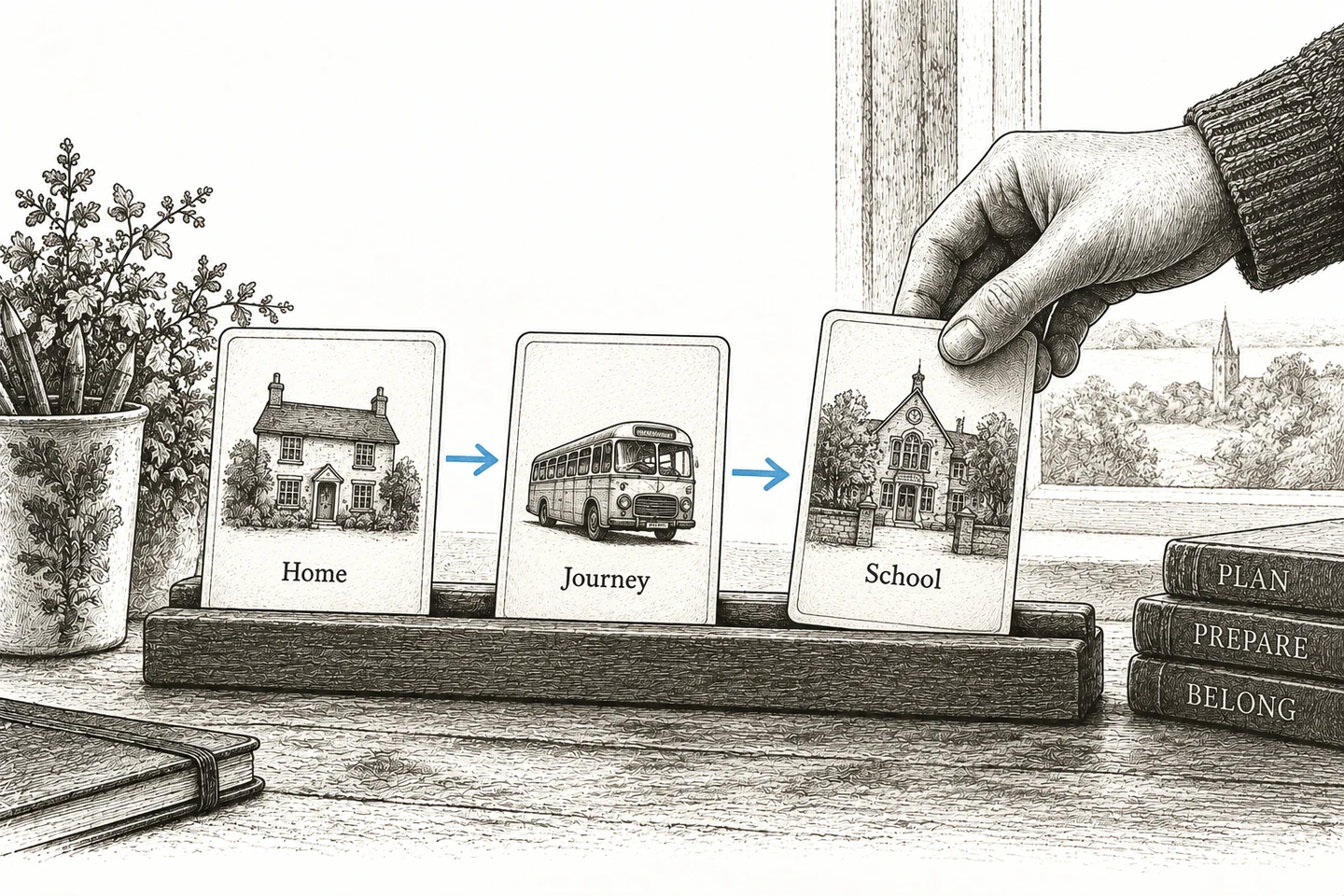
Visual and anticipatory supports keep important information available after spoken words have gone. A short sequence of photographs, an object, a written checklist or a clear timetable can show what is happening, what comes next and what can change.
They may be worth exploring when instructions are lost, a routine has several steps or uncertainty makes a transition difficult. First identify which information is missing or hard to retain. Choose a format the young person understands, introduce it and keep it where it is needed.
Adults are responsible for keeping the information accurate. Show changes honestly and include a usable way to ask for help, question a step or stop. Written directions do not solve an information barrier if reading the words is itself difficult; symbols are not automatically easier.
A predictable activity can still be painful, unsafe or unwanted. A schedule does not replace teaching, communication support or changes to an intolerable destination. Research on taught activity schedules does not establish that every display or warning reduces distress.
Review whether the young person can find and understand the information, how much help or effort is needed and whether they find it useful. Keep task completion separate from understanding, comfort and choice.
The full review
This may be worth exploring when...
- spoken instructions are easily forgotten
- uncertainty creates distress
- transitions are difficult
- routines involve several steps
- the young person repeatedly needs the same information
- understanding improves when information is shown rather than only said
At a glance
Approach type: Practical strategy
Primary purpose: Communication
Also supports: Executive functioning · Participation · Regulation · Learning
Scope: Individual · Classroom · Whole setting
Tier: Universal → individualised
These describe possible implementation settings, not equivalent evidence across populations or tiers. The strongest fit in the reviewed literature is specific, taught schedule use for defined tasks; ordinary information access is also supported by guidance.
Not the same as
- covering every wall in symbols
- replacing useful spoken communication
- using infantile materials with older young people
- rigidly enforcing a visual schedule when circumstances change
What does the adult change?
The adult changes the availability and usability of information: identify what is being lost or misunderstood, make that information persistent in an accessible format, check its meaning with the young person, and update it when the plan changes. Include how to ask for help, question a step or respond when the expected sequence is no longer accurate. A display on the wall is not enough if the person cannot understand it or reach it when needed.
Keep the target clear. Making instructions available is different from teaching the reading skills needed to decode those instructions. When reading itself is difficult, check a demonstrated, pictured, object-based or other accessible route rather than assuming a written list solves the information barrier. Record any literacy teaching separately; following a displayed sequence does not show that decoding was taught.
Distinguish the function
| Use | What the material does | Boundary to retain |
|---|---|---|
| Step display | Keeps an activity or route sequence available. | Check understanding, accuracy, updates and a usable route to question or stop. |
| Social narrative | Gives an authored account of a particular situation, perspectives or possible responses. | Describe the account and how it is used; pictures alone do not make a social narrative. |
| Expressive augmentative and alternative communication (AAC) | Provides a way for the person to select or compose their intended message. | Check access, authorship, vocabulary and partner response; completing steps does not establish expressive communication. |
These functions can coexist. American Speech-Language-Hearing Association (ASHA)’s AAC guidance includes visual schedules within aided AAC and describes systems that combine modes and components. A step display therefore may belong within AAC, while still not describing the whole expressive system. Keep the person’s communication available alongside the display. ASHA supports this functional boundary, not a comparative effectiveness claim.12 The social-narrative distinction follows the existing A021 article boundary.
What it looks like in practice
This is a constructed illustration, not a reported case or an observed outcome.
Imagine a pupil who loses part of a spoken instruction to put equipment away, collect a coat and meet transport at reception. The pupil also finds the words on a written checklist difficult to decode. Repeating the whole sentence or handing over more written directions leaves the actual information barrier unresolved.
The adult checks which part was understood and tries a short sequence using familiar photographs, objects or a demonstration, with the pupil helping select a usable format. Each step remains available at the point it is needed. The pupil has a way to ask for clarification, and the adult updates the sequence if the meeting point changes instead of treating the old display as a rule.
Review would examine whether the pupil could identify and return to the relevant step, whether adult information stayed accurate, and what effort or help was needed. Any support for reading would have its own teaching goal and review. Finishing the sequence would not establish improved decoding, reduced distress or that the same format works elsewhere.
Core components
Accessible format
The support must be understandable to the person using it.
Relevant information
Include what genuinely helps rather than every possible detail.
Availability
The information needs to remain accessible at the point it is needed.
Consistency
Adults should understand how the support is intended to work.
Respectful design
Materials should be appropriate to the young person's age, preferences and communication style.
How it can be adapted
Possible formats include:
- written lists
- photographs
- symbols
- drawings
- objects
- timers
- calendars
- maps
- checklists
- flowcharts
- digital reminders
- worked examples
Who can use or deliver it?
Making information accessible can be part of ordinary educational practice. Adults need to check what the person understands, how the support is accessed, and who will keep it accurate. National Institute for Health and Care Excellence (NICE) recommends visual information meaningful to the individual; this is guidance, not a school-programme trial.13
More specialist communication input may be useful where a young person has significant receptive-language or AAC needs. ASHA describes individual assessment of communication modes, symbols and access.12
Why might it help?
A persistent cue gives the person something to return to after speech has ended. As a practical rationale, this may reduce the need to hold an instruction or sequence in mind. It is not evidence that every visual support improves working memory, language processing or time perception. Written words, pictures and objects all still require an accessible meaning.
Schedule studies generally test whether people complete or move between activities after being taught to use the schedule. That outcome should not be renamed a change in an underlying cognitive ability. Anticipatory information addresses uncertainty only when missing or unclear information is part of the difficulty; it does not change an aversive destination merely by making it predictable.10
Strengths
Simple materials offer options for an individual trial, but cost, preparation, teaching and updating vary. The reviewed evidence does not establish that every application is inexpensive or effortless.
Taught activity-schedule packages can support more independent performance of particular sequences. This is narrower than saying that all visual aids reduce prompting or increase independence. A picture-sequence study with four students with intellectual disability reported better completion after verbal directions and community transfer, but only its abstract was accessible for this review.7
Limitations
Visual support will not solve a demand that is inherently intolerable.
Making something predictable does not necessarily make it manageable.
Check whether the material adds clutter, effort, frustration or unwanted attention for this person. These are matters to ask about and monitor, not quantified harm rates from this review.
The evidence distinguishes completing a transition from feeling safe, understanding it, or wanting to participate. Those outcomes need separate review.
Things to use carefully
- avoid visual clutter
- do not assume symbols are easier than written words
- avoid using visual systems to enforce compliance
- update information when plans change
- remove supports that no longer help rather than allowing them to accumulate indefinitely
Bringing it into practice
- identify which information is repeatedly lost or misunderstood
- decide whether making it persistent would help
- choose the simplest accessible format
- introduce it clearly
- ensure it is available where needed
- review the intended outcome: access to the information, correct use, needed help, effort and the young person’s experience; record task completion separately
- adapt according to the young person's feedback
A decrease in adult prompts can be useful when it reflects usable independent access. It should not become a requirement to remove a support the person still chooses or needs.
What the evidence supports
The evidence belongs to particular uses and packages. It does not justify one effectiveness rating for every timetable, picture, object, written list, warning or communication aid.
Activity and task schedules. The recent academic review included 10 single-case studies with 31 autistic participants aged 4–19. Schedules were usually combined with prompting or reinforcement; improvements in engagement or task performance therefore concern those packages. Maintenance was less consistently examined, and autistic participants’ views were mixed.3 The foundational photographic-schedule study also taught schedule use through graduated guidance. Its accessible abstract reports independent activity sequences and generalisation; it does not show that merely presenting pictures teaches a new task.6
Transition information. Advance notice is not reliably sufficient on its own. In a small component study, visual schedules alone did not reduce transition-related behaviour, whereas extinction plus differential reinforcement did, with or without schedules.4 That finding establishes an attribution limit, not a reason to copy a restrictive procedure. A later two-child study found schedule-plus-choice effects more consistent than schedule alone, but it did not isolate choice alone or directly measure task accuracy.5 Review the reason the transition is difficult and the acceptability of the next activity rather than escalating reminders because a picture has been shown.
Broad reviews and guidance. National Clearinghouse on Autism Evidence and Practice (NCAEP) classifies visual supports as an evidence-based category, but that category includes scripts, work systems and other forms, often in combined interventions.1 A 2026 synthesis of transition interventions found heterogeneous and statistically inconclusive overall effects; it searched selected behaviour-analytic journals only through July 2023 and did not formally appraise study bias.11 Neither result establishes an A006-wide effect on anxiety or distress. Guidance supporting meaningful accessible information and continued AAC access has a different role from comparative efficacy evidence.1213
What remains uncertain. The reviewed sources do not establish a single effect, optimal dose, best format or cost for this whole approach. They do not show that a displayed sequence teaches decoding, changes time perception, or improves everyone’s wellbeing. Staff ratings and task performance cannot substitute for the person’s account. The accompanying evidence profile records study designs, co-components, access limits and conflicting source counts; no inherited headline rating has been adopted.
Source notes
- 1.
Evidence-Based Practices for Children, Youth, and Young Adults with Autism. Steinbrenner et al.; UNC NCAEP, 2020 report; updated ASI terminology in available version. Access: Official full PDF; methods, Table 3.1 and VS appendix inspected.
↩1 - 3.
The use of visual schedules to increase academic-related on-task behaviors of individuals with autism: a literature review. Liang, Lee, Zuo & Liang; online 12 September 2024; current issue 72(6):1326–1339. Access: Publisher indexed full-text methods/results/discussion available; direct reopen/PDF failed; embedded tables not inspected.
↩1 - 4.
Separate and combined effects of visual schedules and extinction plus differential reinforcement on problem behavior occasioned by transitions. Waters, Lerman & Hovanetz; JABA 42(2):309–313 (2009); DOI 10.1901/jaba.2009.42-309. Access: Complete original article PDF via ERIC.
↩1 - 5.
Reducing Escape-Maintained Challenging Behavior in Children with Autism Spectrum Disorder through Visual Activity Schedule and Instructional Choice. Lory, Rispoli, Gregori, Kim & David; Education and Treatment of Children 43:201–217 (2020). Access: Public author-posted full text inspected; publisher metadata/abstract; no login/paywall bypass.
↩1 - 6.
Teaching children with autism to use photographic activity schedules: maintenance and generalization of complex response chains. MacDuff, Krantz & McClannahan; JABA 26(1):89–97 (1993). Access: Original publisher abstract; open PMC scans could not be accessed.
↩1 - 7.
The Effects of a Picture Activity Schedule for Students With Intellectual Disability to Complete a Sequence of Tasks Following Verbal Directions. Duttlinger, Ayres, Bevill-Davis & Douglas; online October 2012; 28(1):32–43 (2013). Access: Publisher abstract/metadata only; full-text retrieval unsuccessful.
↩1 - 10.
Advance Notice for Transition-Related Problem Behavior: Practice Guidelines. Brewer, Strickland-Cohen, Dotson & Williams; Behavior Analysis in Practice 7(2):117–125 (2014). Access: Full PMC article text inspected.
↩1 - 11.
Interventions for Transition-Related Challenging Behavior in Individuals with Disabilities: A Targeted Research Synthesis and Meta-Analysis of Studies Published in Behavior Analytic Journals. Kim, Ravichandran, Moeyaert, Ditzler, Ryan & Fienup; Behavior Modification 50(3):212–247 (2026). Access: Full publisher PDF; methods, results and limitations inspected.
↩1 - 12.
Augmentative and Alternative Communication (AAC). American Speech-Language-Hearing Association; current undated practice portal inspected 11 September 2026. Access: Full web text; AAC Systems/Forms/Symbols and visual schedules sections inspected.
↩1 ↩2 ↩3 - 13.
Autism spectrum disorder in under 19s: support and management, CG170. NICE; published 28 August 2013, updated 14 June 2021. Access: Official recommendation text and metadata retrieved in indexed results; full current guideline/PDF not successfully opened.
↩1 ↩2
About this review
This review retains the source-specific findings and limits of the September 2026 review. This is a targeted review, not an exhaustive systematic review, a formal evidence grade or a completed specialist consultation. It does not determine which support is right for an individual young person.
Encyclopaedia topic connections
These working tags describe the approach’s focus. Conditional connections depend on the particular barrier, goal and application. They do not replace professional delivery roles.
Direct focus
- 02 Thinking, attention & action — Keeping sequence, upcoming events and changes available supports tracking what happens and what comes next.
- 03 Communication & connection — Making important information understandable, persistent and available is central throughout this approach, including instructions, choices and changes.
Conditional connections
- 01 Emotional life & regulation — Relevant when the support addresses distress associated with uncertainty or change; predictability alone does not establish reduced distress.
- 06 Agency, safety & participation — Relevant when accessible information and options help the young person navigate a chosen activity or request a change.
Review and source history
Open Beta v0.2 · Editorial edition · 16 September 2026
The current edition is Open Beta. Directors will onboard after Beta launch; full specialist and youth reviews are planned for Alpha. Earlier records below describe the underlying source and retain its evidence limitations.
Review and source record
Version: recovered-source evidence-reviewed working draft v0.2 Evidence review: 11–12 September 2026; final checks: 12 September 2026 Selected source: complete captured conversation article dated 30 August 2026 Evidence status: targeted source-level reconstruction; findings bounded by component, outcome and access level Review status: evidence-reviewed working proposal; editorial adoption and publication approval pending
Bank consistency edition: v0.1 — 13 September 2026. The version and review-status lines in this record describe the underlying document. Evidence dates and source limitations are retained; this edition makes editorial and navigation changes without new evidence grading. Human specialist/recipient review, adoption and publication remain pending. Current detailed evidence profile. Editorial change record (internal editorial record).
Source provenance and evidence limits
This revision starts from the complete filed recovered-source integration draft v0.1 and its complete captured conversation article of 30 August 2026. It is an evidence reconstruction, not recovery of the unavailable historical ten-entry canonical master. Equivalence to that binary remains unverified. The later recovered profile’s citation handles and ratings were treated as leads, not findings.
The present review, conducted 11–12 September 2026, is targeted rather than exhaustive. It inspected primary studies, original reviews and official guidance at the access levels stated in the detailed evidence profile. Some sources were available only as abstracts or indexed passages; unavailable methods, outcomes and harms are not supplied by inference. No formal GRADE rating or publication approval is claimed.
The selected complete captured article (internal editorial record) and filed v0.1 (internal editorial record) remain unchanged. Exact before/after changes, source and claim decisions, and hashes are in the A006 review records (internal editorial record).
Remaining review
- Reconcile against the reported Batch 02 master if it becomes available; do not relabel this reconstruction as exact recovery.
- Resolve the conflicting NCAEP/AFIRM category counts before using a design breakdown; the recovered 62 single-case/3 group split remains unverified.
- E014 retains a stale statement describing A017 as planned; the correction remains an open pilot action and was not applied here.
- The optional E075 paired-reading gap remains open; E075 has not been added as a fourth link.
- Editorial adoption, practitioner/recipient review where needed, and publication approval remain pending. Phoenix Encyclopaedia links and topic proposals do not establish clinical suitability.