
E006 · Thinking, attention & executive function
Executive-function difficulties
Does this young person know what to do but struggle to turn that knowledge into action?
Phoenix Encyclopaedia
Overview
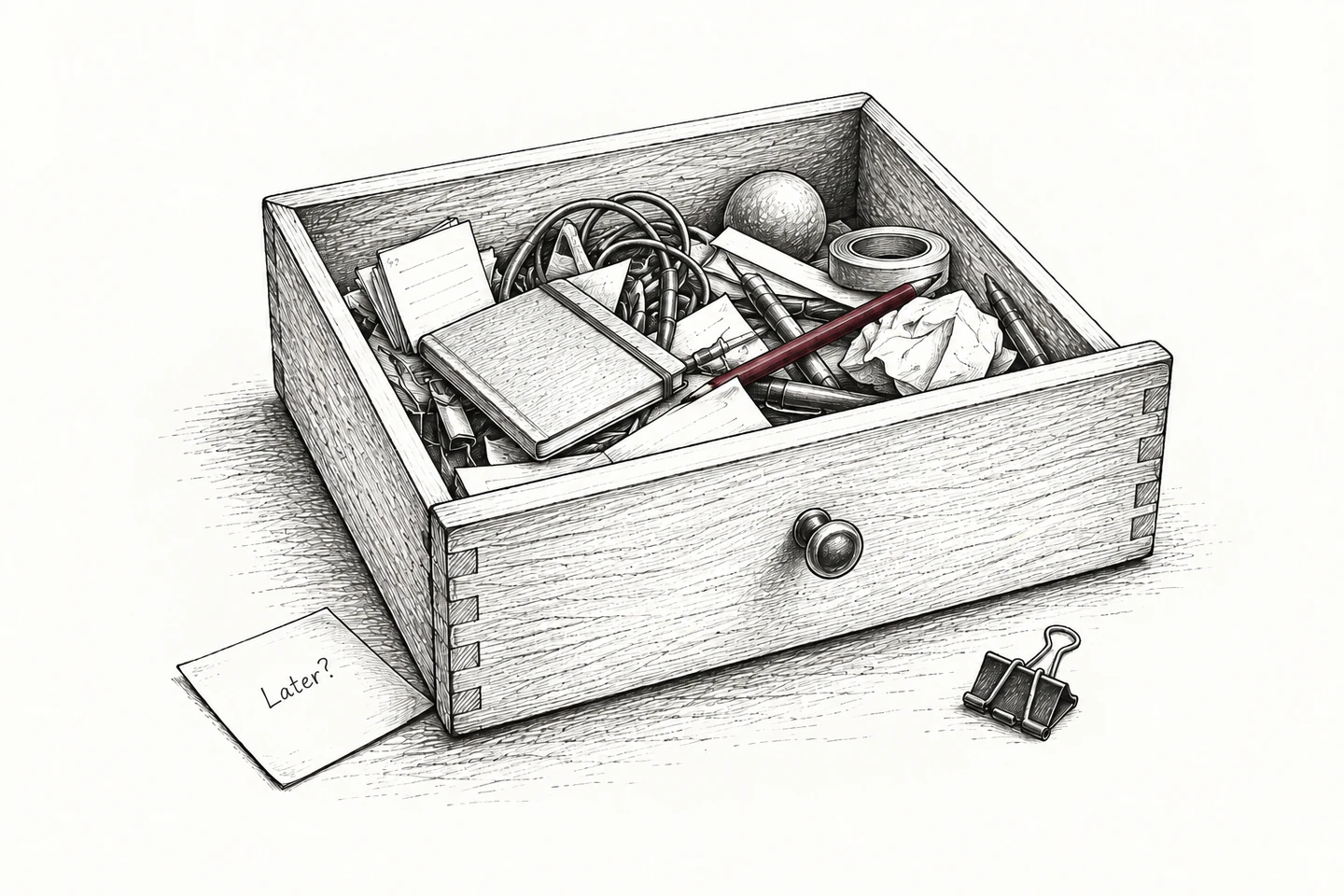
Executive functions are the mental processes that help us turn intentions into action.
They support capacities such as:
- beginning;
- stopping;
- planning;
- organising;
- remembering what we are doing;
- holding information in mind;
- shifting attention;
- managing competing priorities;
- monitoring progress;
- inhibiting immediate responses;
- estimating time;
- completing multi-step activities.
A young person can understand exactly what needs to happen and still struggle to make it happen independently.
This distinction between knowing and doing is central.
Executive-function difficulty is not a lack of intelligence, motivation or understanding.
Capacity can also change significantly according to context and state. Executive functioning often becomes less reliable when a young person is tired, anxious, emotionally dysregulated, sensory overloaded, hungry or under excessive cognitive demand.
Phoenix Encyclopaedia
What this might look like
A young person might:
- struggle to begin work;
- appear to sit doing nothing despite understanding the task;
- lose equipment;
- forget instructions;
- start several things without completing them;
- become overwhelmed by multi-step tasks;
- underestimate how long things will take;
- repeatedly miss deadlines;
- struggle to move between activities;
- need prompts for familiar routines;
- forget what they intended to say or do;
- become distracted by competing information;
- struggle to prioritise;
- complete work inconsistently;
- seem highly organised in one context and very disorganised in another;
- rely heavily on adults without appearing to develop independence;
- become distressed when expected to organise themselves quickly.
A young person may genuinely intend to complete something and later be unable to explain why it did not happen.
Don’t assume
Do not assume that:
- remembering once means the young person can remember reliably;
- understanding an instruction means they can execute it;
- incomplete work reflects lack of effort;
- repeated reminders teach independence;
- losing equipment means the young person does not care about it;
- inconsistent performance proves deliberate choice;
- executive support is “doing it for them”.
A difficulty can be real even when the young person sometimes demonstrates the underlying skill.

Phoenix Encyclopaedia
Developmental expression
At this stage
Early childhood
Executive-function differences may appear through difficulties following sequences, shifting activities, remembering routines, organising play or inhibiting immediate responses.
At this stage adults naturally provide substantial executive support, so differences may be less obvious.
Early childhood
Executive-function differences may appear through difficulties following sequences, shifting activities, remembering routines, organising play or inhibiting immediate responses.
At this stage adults naturally provide substantial executive support, so differences may be less obvious.
Middle childhood
Expectations increase for remembering equipment, beginning work independently, following multi-step instructions, managing time and organising belongings.
This is often when a gap emerges between what the young person understands and what they can reliably organise themselves to do.
Early adolescence
Secondary environments substantially increase executive demand.
Young people may need to manage multiple teachers, rooms, deadlines, homework systems, equipment and longer-term tasks simultaneously.
Difficulties can be mistaken for laziness, carelessness or lack of commitment.
Later adolescence
Expectations increasingly involve self-directed study, appointments, money, travel, employment and future planning.
A young person with strong knowledge or verbal ability may still require significant external scaffolding.
Chronological age does not automatically create executive independence.
Choose each stage to see how the presentation and surrounding expectations may change over time.
Phoenix Encyclopaedia
Strengths and differences
Young people with executive-function differences may also demonstrate:
- strong creativity;
- spontaneous thinking;
- intense concentration when engaged;
- rapid idea generation;
- strong problem-solving in the moment;
- unusual connections between ideas;
- flexibility in some contexts;
- significant knowledge;
- enthusiasm;
- capacity to perform extremely well when external structure is available.
The presence of executive difficulty does not tell us the limit of the young person’s capability.
Often it tells us something about the conditions required to access it.
Phoenix Encyclopaedia
Top tips
- Externalise organisation.
- Break tasks into visible steps.
- Reduce unnecessary working-memory demand.
- Make starting easier.
- Make time visible.
- Give one usable instruction rather than several competing ones.
- Create consistent locations for important items.
- Provide prompts before failure rather than after it.
- Gradually transfer responsibility rather than abruptly removing scaffolding.
- Notice when anxiety or overload is reducing executive capacity.
Try asking
“Is this a knowledge problem, or an access-to-execution problem?”
And:
“What are we currently asking the young person to hold in their head that could be placed into the environment instead?”
Phoenix Encyclopaedia
Things needing careful planning
Consider executive demand around:
- arriving prepared;
- timetable management;
- homework;
- coursework;
- examinations;
- long-term projects;
- changing rooms;
- transport;
- independent study;
- moving between lessons;
- remembering medication or equipment where relevant;
- managing digital platforms;
- preparation for adulthood.
Phoenix Encyclopaedia
Practical support principles
A useful sequence is:
Externalise → simplify → sequence → prompt → practise → gradually transfer
Helpful approaches include:
- visual task sequences;
- checklists;
- timers and visible time;
- calendars;
- reminders;
- structured workspaces;
- breaking tasks into smaller units;
- explicit start points;
- models of completed work;
- reducing working-memory load;
- consistent routines;
- organised storage;
- advance preparation;
- supported planning;
- collaborative problem-solving;
- structured choice;
- environmental adaptation.
Good executive support does not replace independence.
It creates the structure within which independence can become possible.

From understanding to support
Phoenix Atlas connections
Core
- Visual and anticipatory supports
- Environmental adaptation
- Structured choice
Often useful
- Collaborative problem-solving
- Functional assessment / formulation-based assessment
External organisational scaffolds should be treated as accessibility tools rather than evidence that a young person has failed to become independent.
Phoenix Encyclopaedia
Evidence and cautions
Executive function is not a single skill. Its components develop across childhood and adolescence, and performance varies with task, environment and emotional state. (1)
Reviews of executive-function assessment show that structured test performance and everyday functioning are related imperfectly; measurement tools also vary in what they capture. A skill demonstrated once in quiet one-to-one conditions should not be assumed to be reliably available in a busy classroom. (2; 3)
Phoenix therefore distinguishes capability from consistently available performance. Intervention research also cautions against assuming broad transfer from trained tasks. Support should gradually increase the young person's capacity to use tools, recognise needs and organise support across settings, rather than simply reproduce an adult's organisational system. (4)
Phoenix Encyclopaedia
Public evidence sources
- 1. Executive-function development in childhood and adolescence — review.
- 2. Ecological validity of executive-function tests — systematic review.
- 3. Performance-based executive-function instruments for children — systematic review.
- 4. Executive-function interventions in children and adolescents — systematic review and meta-analysis.
Phoenix Encyclopaedia
Possible explanatory lenses
Executive-function differences may occur alongside ADHD, autism, learning needs, developmental differences, anxiety, trauma, sleep difficulties, mood difficulties, sensory overload or high environmental demand.
Whatever explanatory lens is considered, the practical question remains:
What is preventing intention from becoming action?
About this entry’s source
Open Beta · read the evidence notes and limitations
Source status describes the underlying material. The current site edition is Open Beta; the evidence notes and limitations remain part of the entry.